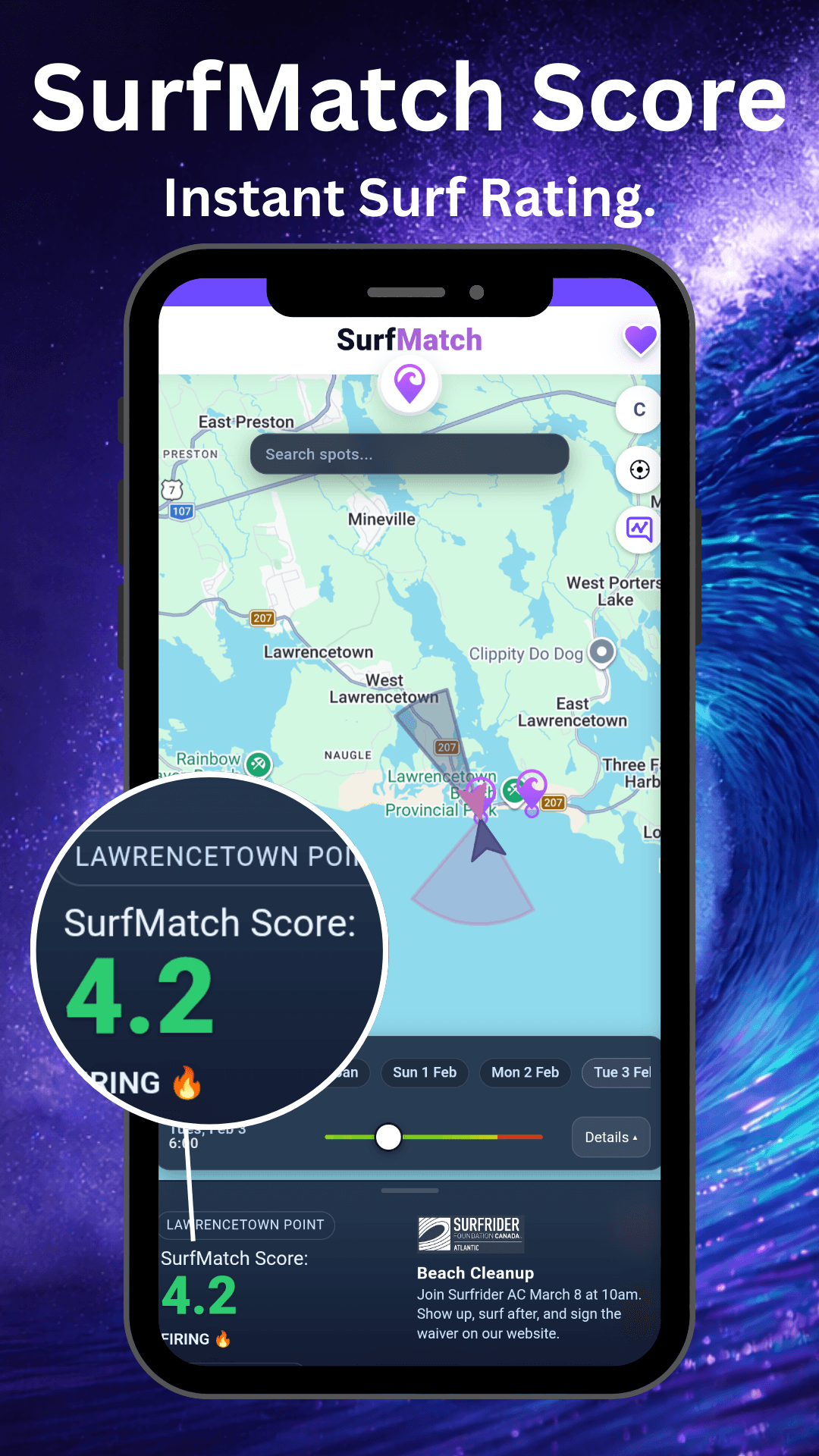
Simple by Design: The Tech Behind the SurfMatch Score
TL;DR:
The Forecast Paralysis Trap: Traditional surf apps dump raw data tables, conflicting models, and complex charts onto your screen, forcing you to do math before a sunrise session.
Heavy Tech Under the Hood: SurfMatch ingests live offshore buoy telemetry, spectral energy, local wind models, and underwater bathymetry behind the scenes.
Distilled Simplicity: All that complex oceanography is processed into a single, intuitive SurfMatch Score—a clear, visual "go/no-go" decision so you spend less time reading charts and more time in the lineup.
If you open most popular surf forecasting apps today, you are immediately bombarded with a wall of noise: multi-colored wind vectors, six different swell direction arrows, conflicting wave height ranges, and endless raw data tables.
Somewhere along the line, surf forecasting apps started assuming that dumping raw oceanographic data onto your screen was the same thing as giving you a good forecast. It isn’t. It’s just homework.
When I designed SurfMatch, I took the exact opposite approach. If you look at SurfMatch and think, "This looks almost too simple," that is by design.
Here is a look under the hood at how SurfMatch processes complex marine telemetry behind the scenes to deliver a clean, instant, visual decision on your screen.
1. The Heavy Engine: Live Buoy Integration
A forecast model is only as good as its real-time grounding. Standard apps rely heavily on global mathematical models that run every six hours. But ocean conditions shift minute by minute.
SurfMatch plugs directly into a global network of live offshore ocean buoys. Instead of just taking the app's word for what might happen, SurfMatch continuously pulls raw telemetry straight from the water:
Real-time spectral energy density
Dominant and secondary swell periods
Primary wave direction and directional spread
By tracking live buoy data in real time, the app catches sudden period spikes, building groundswells, and hidden secondary energy before global models even update.
2. The Brain: SurfMatch Intelligence
Raw data alone doesn't tell you if a beach is good. A 4-foot swell with a 14-second period means one thing to a steep, shallow reef break and something completely different to a flat, sandy beach break.
This is where SurfMatch Intelligence takes over. The background engine takes that live buoy telemetry and runs it through a localized filter:
Bathymetric Mechanics: How the local underwater topography refracts and amplifies incoming swell energy.
Wind Shadowing: How nearby headlands, cliffs, and coastal topography block or funnel regional winds.
Optimal Windows: The exact tide range, swell angle, and wind sector required to make a specific break light up.
Instead of asking you to cross-reference five different charts to figure out if the wind angle aligns with the reef contour, SurfMatch Intelligence does the calculations for you automatically.
3. The Output: The SurfMatch Score
All of that heavy marine data, real-time telemetry, and bathymetric math gets distilled into one primary metric: The SurfMatch Score.
The SurfMatch Score is a clean, visual index that tells you instantly whether a spot is firing, manageable, or blown out.
No Information Overload: You don't need to decipher conflicting secondary swell tables while sitting in your car at dawn.
Clear Go/No-Go Decision: The score gives you an immediate, digestible snapshot of how closely current conditions match the optimal profile for that specific wave.
4. Zero Friction: Favorites & Quick Checks
Surfing is all about timing. When you have a 45-minute window before work, you don't have time to tap through multiple sub-menus and analyze raw charts for six different beaches.
With Favorites, you save your local breaks to your personal dashboard. Opening the app gives you an immediate glance at the live SurfMatch Scores across your entire regional lineup in under three seconds. You can instantly see which spot is holding the current wind and tide, pick your beach, and get in the water.
Complexity Belongs in the Code, Not on Your Screen
Making an app look complex is easy—you just display all the raw data you collect. Building an app that feels simple is much harder, because it requires the code to do the heavy lifting of interpretation, filtering, and cross-referencing for you.
SurfMatch doesn't hide the ocean's complexity to dumb things down; it processes that complexity behind the curtain so you can make faster, smarter decisions without the forecast fatigue.
Less time analyzing charts. More time riding waves.