
Decoding SurfMatch Intelligence: The Architecture of
Next-Gen Surf Forecasting
TL;DR:
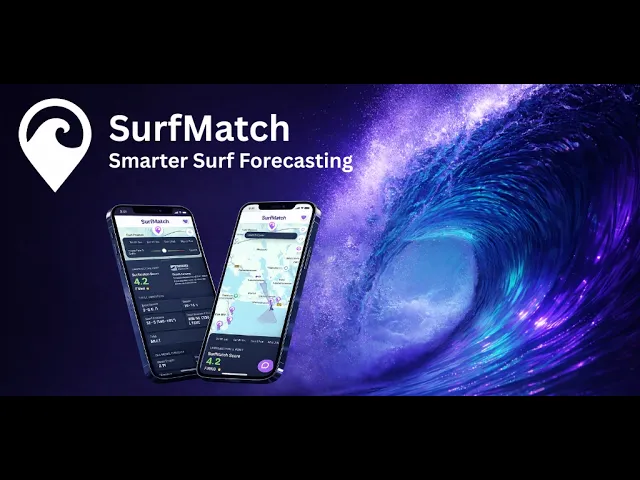
The Problem: Traditional forecasts offer generic, regional data averages, forcing surfers to manually calculate the impact of wind, tide, and local bathymetry, or use multiple apps to piece together the important details that their unique surf spot requires. Many people use between 3-5 apps to verify the forecast. These tools often present as something a meteorologist would understand. confusing jumbled data and numbers with lines and colors etc etc. SurfMatch manages all the things the usual 3-5 apps do, including the technical analysis behind the scenes and presents the forecast in a visual manner and a simple, clear score between 1 and 5 to help surfers know when the surf at their specific spot is good or bad.
The Deterministic Core: SurfMatch replaces guesswork with a proprietary engine that cross-references live offshore buoy data and 14-day GFS models against hard-coded, spot-specific ideal parameters to output a precise 0–5 SurfMatch Score.
The Intelligence Layer: The SurfMatch AI Agent isn't a basic chatbot. It ingests the live ocean telemetry, local wave energy ($E \propto H^2 T^2$), and the user's specific saved bio including quiver (board volume, fin setups), skill level and preferences to deliver highly personalized session advice.
The Trip planner: We have built an automated, global strike mission planner and predictive virtual coaching element that adapts to your specific skill tier and equipment.
For decades, surf forecasting has been an exercise in translation. Surfers are forced to act as amateur oceanographers—staring at raw NDBC buoy data, parsing GFS model wind vectors, and mentally cross-referencing it all with the local bathymetry of their home break.
SurfMatch was built to eliminate that cognitive load.
At its core, SurfMatch is not just a weather app; it is a proprietary forecasting engine and AI intelligence layer designed to convert the chaos of raw ocean data into deterministic, highly actionable insights. Here is a deep dive into the technology powering SurfMatch Intelligence, how the architecture works today, and where we are taking it next for strike mission planning and elite coaching.
1. The Deterministic Core: The Scoring Engine
The foundation of SurfMatch is our proprietary scoring algorithm (scoring.js). Before the AI agent ever sees the data, the system ingests a massive pipeline of meteorological and marine inputs.
We pull real-time offshore marine swell monitoring via live buoy data and combine it with 14-day extended window forecasting from GFS models. But raw data is useless without context. The magic happens in the localized matching logic.
Every surf spot in the SurfMatch database has a hard-coded profile of Ideal Conditions:
Swell Vectors: Specific height, period, and directional windows (e.g., S–SSW 200–235°).
Wind Vectors: Acceptable wind speed and direction thresholds for offshore or glassy conditions.
Tidal Dependencies: Low, mid, or high tide sensitivities.
The engine runs a multi-variable comparison between live/forecasted data and these ideal parameters. The output is the SurfMatch Score—a precise 0 to 5 rating. When the algorithm detects complete alignment across all variables, the system triggers a FIRING 🔥 status (typically a 4.5 or 5.0), letting you know instantly that the spot is on.
2. Advanced Oceanographic Modeling: Bathymetry & Amplification
Standard forecasting models treat the ocean floor as flat, providing regional averages that fail to capture local nuances. SurfMatch Intelligence is built to go deeper.
Our models account for deep-water canyon amplification and localized refraction. Consider a break with a deep-water trench offshore. A standard model might read a 5.2ft swell at 14 seconds and predict shoulder-high waves. However, long-period swells carry kinetic energy deep below the surface.
By analyzing the specific energy density of a swell—where energy is proportional to the square of both the wave height and the wave period ($E \propto H^2 T^2$)—SurfMatch calculates the true impact of the swell when it hits a sudden shallow shelf. This allows us to predict exponential wave height amplification, delivering a highly accurate, localized forecast rather than a generic regional guess.
3. The Personalization Engine: Dynamic Quiver & Experience Mapping
A 6-foot hollow reef break at low tide might be a 5.0 FIRING score for a veteran charger on a step-up, but completely unmanageable or unsafe for someone riding a low-volume groveler or working on their line-up positioning. Generic scores only tell half the story. To deliver true utility, SurfMatch integrates a proprietary User Profile & Quiver Schema.
Data Capture & Persistence
During onboarding and user management, the app creates a persistent document in Firebase Firestore containing three primary data objects:

Dynamic Context Injection
When a user initiates an inquiry with SurfMatch Intelligence, the frontend dynamically serializes this Firestore profile and prepends it to the LLM system prompt alongside the spot’s live oceanographic telemetry.
Instead of evaluating conditions in a vacuum, the AI agent cross-references:
Wave Energy vs. Board Volume: Matching calculated swell energy ($kW/m$) against board displacement (Liters) to determine if the user has enough paddle speed to get over the ledge.
Swell Period vs. Board Type: Evaluating whether a long-period, fast-moving wave requires a longer rail line (step-up) or if the wave speed suits a high-performance shortboard.
Risk & Skill Alignment: Comparing steepness and tide drop against the user's documented skill tier to provide tailored safety and positioning advice.
4. SurfMatch Intelligence: The AI Agent Layer
This context injection powers the SurfMatch AI Agent (agent.js). This isn't a generic chatbot wrapper; it is a context-aware intelligence layer deeply integrated with both our oceanographic scoring engine and the user’s personal profile.
When you open the SurfMatch Intelligence chat window, the app silently passes a complete, structured payload into the AI's context window:
The target spot and its 0–5 SurfMatch Score.
Precise environmental vectors (Swell height/period/direction, wind speed/direction, tide).
The full 14-day forecast timeline.
The user's active board selection and skill profile.
Because the AI is explicitly grounded in this combined dataset, it performs deep, markdown-formatted analysis on the fly. Ask the agent, "Should I head out to Mawi at 2 PM?" and it won't just tell you the wind speed—it will analyze the incoming SSW swell, cross-reference your 6'3" step-up, and advise:
"The score hits 4.5 FIRING at 2:00 PM as the tide drops to mid. With 5.2ft at 14s, the energy density will double on the shallow reef. Take out your 6'3" Ghost (34.5L)—the extra entry paddle speed will be critical for making the ledge drop before the section folds."
5. Strike Missions & Predictive Coaching
By combining real-time marine data, deterministic scoring, real-time flight information, destination, wave intel, and personalized user schemas, SurfMatch Intelligence unlocks massive capabilities:
Predictive Gear & Lineup Coaching: As historical session data accumulates, SurfMatch Intelligence will learn which boards in your garage perform best under specific swell period and energy thresholds. It will act as a virtual caddy, suggesting exact fin setups, board choices, and lineup entry points before you even pull up to the beach.
Personalized Strike Mission Planning: Instead of manually scanning 14-day charts, users can configure automated background trip monitoring. The system will continuously run multi-variable matching against global marine feeds, alerting you when a forecast window opens that matches your exact quiver and skill comfort zone—giving you the critical lead time needed to book flights and chase the swell.
Real-time Planning Intel: Choose your destination, or get help selecting one. The intelligence engine provides real-time flight times, airlines and prices in the user's local currency., and outlines local accommodation details and wave intel. Once the surfer is happy, the engine packages every single detail into a perfect Surf Trip Plan, and emails directly to the user to execute.
From Chaos to Clarity
SurfMatch was built to solve the friction of modern wave hunting. By pairing a deterministic oceanographic scoring engine with hyper-personalized user context, we aren't just repackaging weather data—we are building the most intelligent, customized surf forecasting platform on the planet.